Click to find
How to Build a Dividend Portfolio for Passive Income
Building a dividend portfolio can be a smart way to create a regular stream of passive income while also growing your wealth over the long term. Instead of relying only on stock price appreciation, dividend investors earn cash payments from companies that share a portion of their profits with shareholders.
The goal is simple: build a diversified portfolio of quality investments that can generate sustainable income and potentially increase that income over time.
What Is a Dividend Portfolio?
A dividend portfolio is a collection of stocks, ETFs, REITs, or other investments that regularly pay dividends. Companies typically distribute dividends from their profits to shareholders, often on a quarterly basis.
For investors, this can create two potential sources of return:
- Regular dividend income
- Long-term growth in the value of investments
A well-structured dividend portfolio focuses not just on finding the highest dividend yield, but on choosing investments with strong fundamentals and sustainable dividend payments.
Step 1: Define Your Passive Income Goals
Before buying any investment, decide what you want your dividend portfolio to achieve.
Ask yourself:
- How much passive income do I want each month or year?
- What is my investment time horizon?
- How much risk am I comfortable taking?
- Do I need income now, or am I building wealth for the future?
For example, if your long-term goal is to generate $1,000 per month in dividend income, you can work backward to estimate how much capital may be needed based on your portfolio’s average dividend yield.
Clear goals help you choose the right balance between income, growth, and risk.
Step 2: Understand Dividend Yield
Dividend yield shows how much annual dividend income an investment pays relative to its current price.
For example, if a stock costs $100 and pays $4 in annual dividends, its dividend yield is 4%.
However, a higher yield does not always mean a better investment. Sometimes a very high dividend yield can be a warning sign that the company’s stock price has fallen or that its dividend may not be sustainable.
Instead of chasing the highest yield, look for a combination of:
- Sustainable dividends
- Financially strong companies
- Consistent earnings
- Reasonable payout ratios
- Potential for future dividend growth
Step 3: Research Quality Dividend Stocks
A strong dividend portfolio starts with quality.
Look for companies that have a history of:
- Paying dividends consistently
- Increasing dividends over time
- Generating stable revenue and earnings
- Maintaining manageable debt
- Having a strong competitive position
It is also useful to examine the company’s payout ratio. A company that distributes nearly all of its profits as dividends may have less flexibility during difficult economic periods.
The ideal investment is not necessarily the company with the biggest dividend today. Often, a reliable company that steadily increases its dividend can be more valuable over the long term.
Step 4: Diversify Your Portfolio
Diversification is one of the most important principles of dividend investing.
Avoid putting all your money into one company or one industry. Instead, spread your investments across different sectors.
A diversified dividend portfolio might include exposure to:
- Blue-chip companies
- Dividend growth stocks
- Real Estate Investment Trusts (REITs)
- Dividend-focused ETFs
- International stocks
Different sectors perform differently depending on economic conditions. Diversification can help reduce the impact if one company or industry faces problems.
Step 5: Consider Dividend Growth
Dividend income can become more powerful when companies increase their payments over time.
Imagine owning a company that pays you dividends today and continues raising those payments over the next several years. Even if the initial dividend yield is moderate, the income generated from your original investment may grow significantly.
Dividend growth can also help investors manage the effects of inflation over the long term.
When researching investments, consider both:
- Current dividend yield
- Potential dividend growth
A balanced portfolio may include a mix of higher-yield investments and lower-yield companies with stronger growth potential.
Step 6: Reinvest Your Dividends
One of the fastest ways to grow a dividend portfolio is through dividend reinvestment.
Instead of withdrawing the dividend income, you can use it to purchase additional shares. Those additional shares may generate more dividends, creating a compounding effect.
Many investors use a Dividend Reinvestment Plan, commonly known as a DRIP.
For example:
Investment → Dividend Payment → Buy More Shares → Receive More Dividends → Repeat
Over a long period, compounding can significantly increase the size of your portfolio and your future passive income.
Step 7: Monitor and Rebalance Regularly
A dividend portfolio should not be completely forgotten after it is created.
Review your investments periodically and watch for changes such as:
- Dividend cuts or suspensions
- Declining company earnings
- Increasing debt
- Major changes in the business
- Overexposure to one sector
Rebalancing may also be necessary if one investment grows to represent too large a portion of your portfolio.
However, monitoring does not mean constantly buying and selling. Long-term dividend investing often rewards patience and disciplined decision-making.
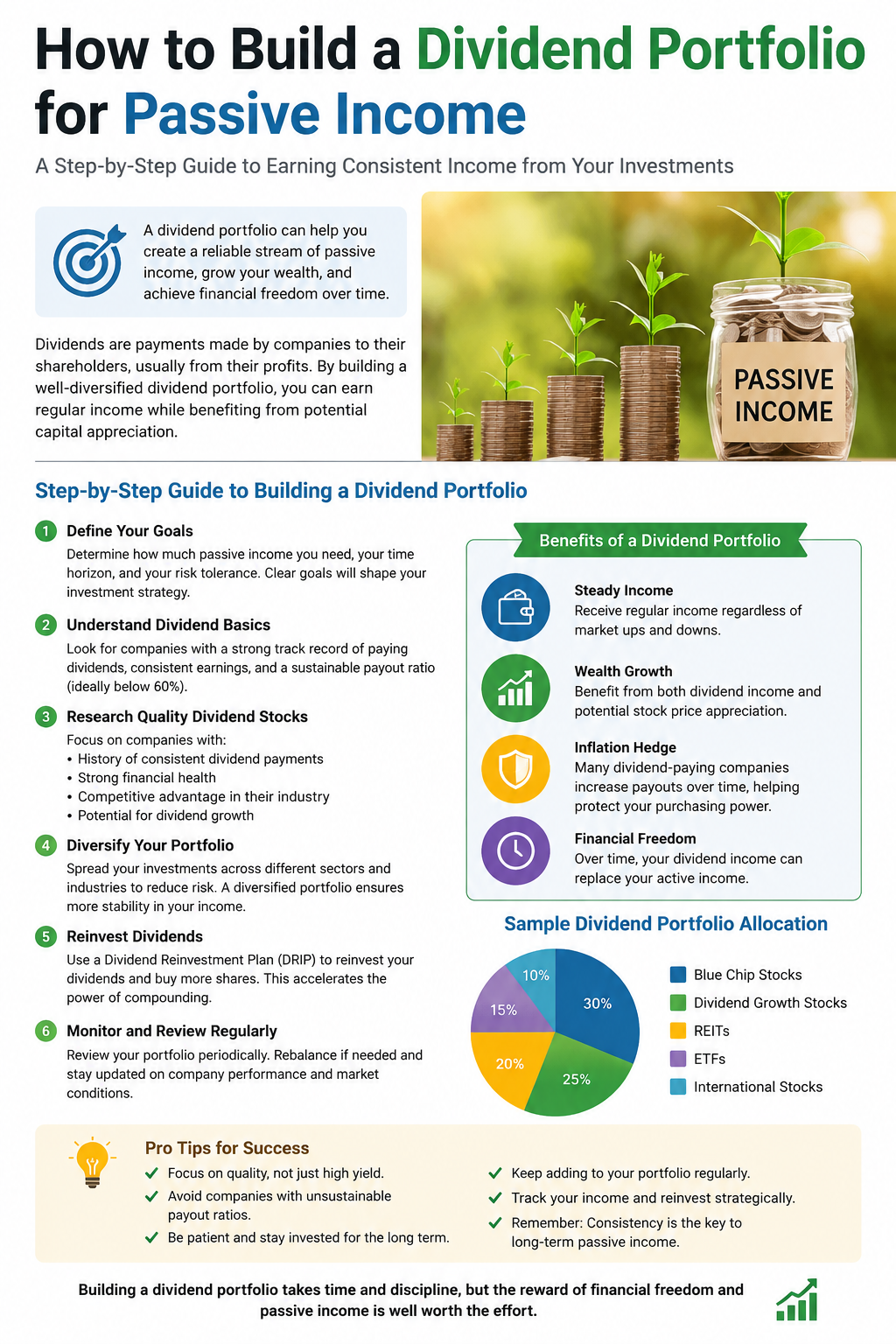
Sample Dividend Portfolio Allocation
Here is an example of how an investor might diversify a dividend-focused portfolio:
- 30% Blue-Chip Dividend Stocks
- 25% Dividend Growth Stocks
- 20% REITs
- 15% Dividend ETFs
- 10% International Dividend Stocks
This is only an example, not a guaranteed strategy or personal investment recommendation. Your allocation should depend on your financial goals, risk tolerance, investment horizon, taxes, and local market access.
Benefits of Building a Dividend Portfolio
1. Steady Income
Dividend-paying investments can provide regular cash payments, which may be useful for investors seeking an additional income stream.
2. Long-Term Wealth Growth
Investors may benefit from both dividend income and potential growth in the value of their investments.
3. Compounding Opportunities
Reinvesting dividends can help accelerate portfolio growth over time.
4. Potential Inflation Protection
Companies that consistently grow their dividends may help investors increase their income over the long term.
5. Financial Flexibility
As a portfolio grows, dividend income can provide additional financial flexibility and reduce dependence on active income.
Common Mistakes to Avoid
When building a dividend portfolio, avoid these common mistakes:
- Chasing extremely high dividend yields
- Investing all your money in one company
- Ignoring company fundamentals
- Forgetting about taxes and fees
- Panic selling during market volatility
- Expecting instant passive income
- Failing to review dividend sustainability
The best dividend strategy is usually based on patience, diversification, and long-term consistency.
Final Thoughts
Building a dividend portfolio for passive income takes time, research, and discipline. The key is to focus on quality investments rather than simply chasing the highest dividend yield.
Start by defining your income goals, researching financially strong companies, diversifying across sectors and investment types, and reinvesting dividends whenever it fits your strategy. Over time, consistent investing and compounding can help build a portfolio designed to generate increasing income.
Remember: successful dividend investing is usually a long-term journey, not a shortcut to instant wealth.
Disclaimer: This article is for educational and informational purposes only and should not be considered financial or investment advice. Always conduct your own research and consider consulting a qualified financial professional before making investment decisions.