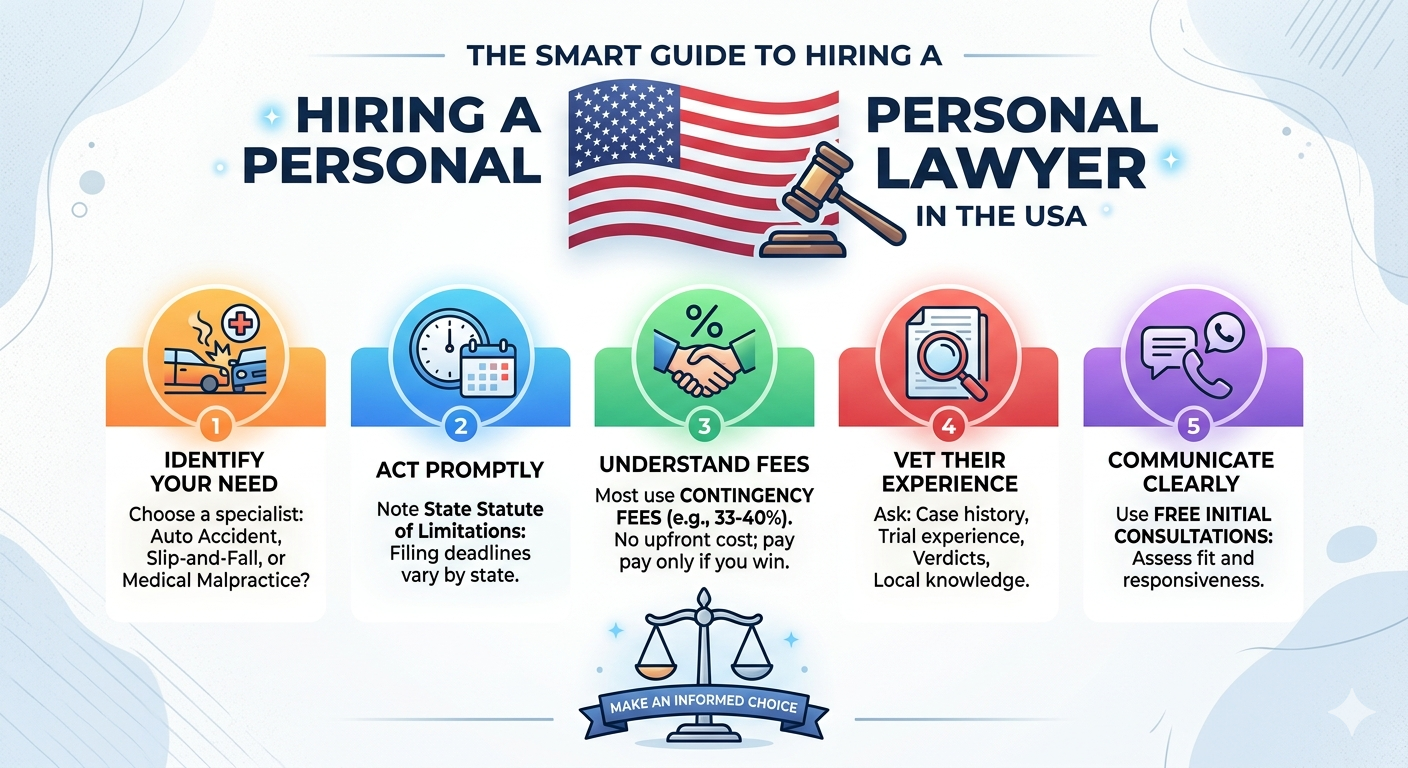
Getting injured in an accident can turn your life upside down in a matter of seconds. One moment you are driving to work, walking through a store, or doing your job, and the next you are dealing with medical bills, lost income, insurance companies, and uncertainty about what to do next.
If someone else’s negligence caused your injury, you may have the right to seek compensation. But knowing that you have a potential claim and actually protecting that claim are two different things.
This is where a personal injury lawyer can make a significant difference.
The right attorney can help you understand your legal options, deal with insurance companies, investigate what happened, calculate your damages, and negotiate for a fair settlement. On the other hand, hiring the wrong lawyer can create unnecessary frustration and may make an already difficult situation even harder.
This guide explains how to hire a personal injury lawyer in the USA, what questions to ask, how contingency fees work, what documents you should prepare, and the warning signs you should watch for before signing a representation agreement.
Important: This article provides general educational information, not legal advice. Personal injury laws, deadlines, filing requirements, and attorney-fee rules vary by state and by the type of claim. Speak with a licensed attorney in the state where your injury occurred for advice about your specific situation.
Click to find
What Is a Personal Injury Lawyer?
A personal injury lawyer represents people who have been physically or financially harmed because of another person’s negligence, wrongful conduct, or, in some cases, a defective product or unsafe condition.
Personal injury cases can involve many different situations, including:
- Car accidents
- Truck accidents
- Motorcycle accidents
- Pedestrian accidents
- Bicycle accidents
- Slip-and-fall accidents
- Workplace-related injuries
- Dog bites
- Wrongful death
- Medical malpractice
- Defective products
- Premises liability
- Construction accidents
Not every injury automatically results in a successful lawsuit. A lawyer will generally need to examine the facts, applicable law, evidence, and potential damages before determining whether pursuing a claim makes sense.
When Should You Hire a Personal Injury Lawyer?
One of the most common questions after an accident is: “Do I really need a lawyer?”
The answer depends on the circumstances.
For a very minor accident with little or no injury and a straightforward insurance claim, you may be able to handle the matter yourself.
However, speaking with a personal injury attorney becomes particularly important when:
- Your injuries are serious.
- You need ongoing medical treatment.
- You cannot work because of your injuries.
- The insurance company disputes responsibility.
- Multiple people or vehicles are involved.
- You believe the settlement offer is too low.
- The accident resulted in permanent disability.
- A government entity may be involved.
- Someone died as a result of the accident.
- The other party does not have adequate insurance.
- Liability is complicated or disputed.
The earlier you get legal advice, the easier it may be for an attorney to identify important deadlines and preserve evidence.
How to Find a Personal Injury Lawyer in the USA
Finding a lawyer isn’t difficult. Finding the right lawyer for your particular case is the real challenge.
Instead of hiring the first attorney who appears in a Google search, create a shortlist and compare them.
1. Search for Lawyers Who Handle Your Type of Case
Personal injury law is a broad category.
For example, an attorney who primarily handles car accidents may not be the best choice for a complicated medical malpractice claim.
Look for lawyers who regularly handle cases similar to yours.
Search terms might include:
- Personal injury lawyer near me
- Car accident lawyer
- Truck accident attorney
- Motorcycle accident lawyer
- Wrongful death attorney
- Slip and fall lawyer
- Personal injury attorney in [your city]
- Personal injury lawyer in [your state]
The important part is not simply finding a lawyer who accepts personal injury cases. You want someone who has meaningful experience with your type of injury and circumstances.
2. Verify the Lawyer’s License
Before hiring an attorney, verify that the lawyer is licensed to practice in the relevant jurisdiction.
State bar organizations and court systems generally provide attorney-license information.
Check whether the lawyer is currently authorized to practice and, where available, review disciplinary information.
Don’t rely solely on a law firm’s website saying that an attorney is licensed.
A basic verification step can help you avoid a major problem later.
3. Look at Relevant Experience
Experience matters, but don’t focus only on the number of years a lawyer has practiced.
Ask about experience with cases like yours.
For example:
Instead of asking:
“How many years have you been a lawyer?”
Consider asking:
“How many cases similar to mine have you handled?”
You can also ask:
- Have you handled cases against the insurance company involved in my claim?
- How many similar cases have you taken to trial?
- What types of injuries do you commonly handle?
- Do you personally handle negotiations?
- Will another attorney handle my case?
- Does your firm have experience with expert witnesses?
A lawyer with relevant experience may understand the common tactics insurers use and know what evidence can make a claim stronger.
4. Read Reviews Carefully
Online reviews can be useful, but don’t treat them as the final answer.
Look for patterns rather than focusing on one extremely positive or negative review.
Pay attention to comments about:
- Communication
- Responsiveness
- Professionalism
- Case updates
- Staff behavior
- Transparency about fees
- Overall client experience
A firm with thousands of reviews isn’t automatically better than a smaller firm with fewer reviews.
Think of reviews as one piece of the puzzle, not the entire decision.
5. Schedule a Consultation
Many personal injury lawyers offer an initial consultation without charging a traditional hourly fee.
The consultation gives both sides an opportunity to determine whether the attorney-client relationship makes sense.
Before the meeting, prepare a simple timeline of what happened.
Write down:
- Date of the accident
- Time of the accident
- Location
- What happened
- Names of people involved
- Witness information
- Police report information
- Medical treatment
- Insurance information
- Lost work or income
- Property damage
- Communications with insurance companies
Being organized can make the initial consultation much more productive.
Questions to Ask a Personal Injury Lawyer
Don’t be afraid to ask questions.
You are not just looking for someone who says they can take your case. You are deciding who will potentially handle an important legal matter involving your health and finances.
Here are some useful questions.
Question 1: Have You Handled Cases Like Mine?
This helps determine whether the attorney has relevant experience.
Question 2: Who Will Actually Handle My Case?
Some firms market a case through one attorney but assign day-to-day work to another lawyer or legal staff member.
Ask who your primary contact will be.
Question 3: How Will We Communicate?
Find out whether you will communicate by phone, email, text, a client portal, or through a paralegal.
Good communication can make a stressful case much easier to manage.
Question 4: What Is Your Fee?
Ask the lawyer to explain the fee agreement in plain language.
Question 5: What Expenses Am I Responsible For?
Attorney fees aren’t necessarily the only costs associated with a case.
There may also be expenses involving:
- Court filing
- Medical records
- Expert witnesses
- Depositions
- Investigations
- Accident reconstruction
- Court reporters
- Other litigation expenses
The American Bar Association recommends discussing legal fees and expenses clearly and getting the arrangement in writing.
Question 6: What Happens If We Lose?
Do not assume that “no win, no fee” means you will never owe anything.
Ask specifically about case expenses and what happens if there is no recovery.
Question 7: How Long Could My Case Take?
No responsible lawyer should guarantee a specific timeline.
However, an experienced attorney should be able to explain the factors that could speed up or delay your case.
Understanding Personal Injury Lawyer Fees
One of the biggest concerns people have is cost.
Fortunately, personal injury cases are commonly handled under a contingency fee agreement.
Under this arrangement, the lawyer generally receives an agreed percentage of the money recovered for the client rather than charging the client an hourly fee throughout the case.
The American Bar Association explains that contingency fees are commonly used in personal injury matters and are often based on a percentage of the recovery.
Cornell Law School’s Legal Information Institute similarly explains that contingency fees generally involve an attorney receiving a percentage of the monetary recovery and that the agreement should be in writing.
How Does a Contingency Fee Work?
Imagine, purely as an example, that your attorney and you agree to a 33.3% contingency fee.
If the case produces a $100,000 recovery, the attorney’s fee under that example would be approximately $33,300.
But there is an important detail:
The exact calculation depends on your written agreement.
Some agreements address case expenses separately. Others specify whether expenses are deducted before or after the attorney’s percentage is calculated.
That’s why you should never assume that two lawyers quoting “one-third” are offering identical financial terms.
Ask:
- What percentage do you charge?
- Does the percentage change if the case goes to trial?
- Are litigation expenses separate?
- Who pays expenses if we lose?
- Are expenses deducted before or after the attorney fee?
- Are medical liens handled by the firm?
- What happens if I terminate the agreement?
These questions can prevent unpleasant surprises later.
Read the Fee Agreement Before Signing
Your representation agreement is important.
Don’t sign it simply because you are sitting in a lawyer’s office and feel pressured to make a decision.
Take time to read it.
The agreement should explain important terms such as:
- Attorney’s percentage
- Costs and expenses
- Responsibilities of the lawyer
- Your responsibilities
- How settlement money is distributed
- What happens if you end the relationship
- What happens if the attorney withdraws
- How litigation affects the fee
The ABA advises clients to understand fee arrangements and expenses before legal work begins.
If something doesn’t make sense, ask.
A good lawyer should be willing to explain the agreement.
What Compensation Can a Personal Injury Claim Include?
Depending on the facts and applicable state law, a personal injury claim may seek compensation for different types of losses.
Potential damages can include:
Medical Expenses
This may include costs associated with emergency treatment, hospital stays, surgery, medication, rehabilitation, physical therapy, and other medically necessary care.
Lost Income
If your injury prevents you from working, you may have a claim for lost wages or income, depending on the circumstances.
Future Earning Capacity
A serious injury can affect your ability to earn money in the future.
In some cases, future economic losses may become an important part of the claim.
Pain and Suffering
Some personal injury claims may seek compensation for physical pain and emotional suffering.
Property Damage
For an automobile accident, property damage may be included in the overall claim, although the legal treatment can vary by situation and state.
Other Damages
Depending on the circumstances, additional damages may be available.
Because damage rules differ significantly among states and types of claims, your lawyer should explain which categories may apply to your situation.
Don’t Accept the First Insurance Settlement Offer Too Quickly
After an accident, an insurance company may contact you about your claim.
You may receive a settlement offer sooner than expected.
It can be tempting to accept the money immediately, especially when medical bills are arriving and you are missing work.
But before accepting a settlement, understand what you’re agreeing to.
A settlement may require you to release certain claims related to the accident.
Once you sign a release, you may have limited ability to seek additional compensation later.
That doesn’t mean every insurance settlement offer is unfair.
It means you should understand the consequences before accepting it.
A personal injury lawyer can review the offer, evaluate the available evidence and help you understand your options.
What Evidence Can Help a Personal Injury Case?
Evidence can become extremely important when liability or damages are disputed.
Depending on the case, useful evidence may include:
- Police reports
- Medical records
- Medical bills
- Photographs
- Videos
- Accident-scene photographs
- Vehicle damage photographs
- Witness statements
- Employment records
- Pay stubs
- Insurance correspondence
- Text messages
- Emails
- Expert reports
- Surveillance footage
- Accident reconstruction evidence
Don’t delete potentially relevant messages, photographs or documents.
Create a folder where you keep copies of everything related to the accident.
Be Careful What You Post on Social Media
Social media can create problems during a personal injury dispute.
A simple photograph or post can potentially be interpreted differently from how you intended it.
For example, someone claiming significant physical limitations could create confusion if they post photos or videos showing strenuous activities.
That doesn’t mean you need to disappear from the internet.
It does mean you should think carefully about what you post and discuss your situation with your lawyer.
Never assume that something posted online cannot become relevant to a legal dispute.
Personal Injury Deadlines: Why Timing Matters
One of the biggest mistakes an injured person can make is waiting too long.
Personal injury claims are subject to statutes of limitations, which are legal deadlines for filing certain lawsuits.
These deadlines aren’t identical throughout the United States.
They can differ based on:
- State
- Type of accident
- Type of defendant
- Injury involved
- Whether a government entity is involved
- Special circumstances surrounding the claim
There can also be circumstances that affect how a deadline is calculated.
Because missing a filing deadline can seriously affect your legal rights, don’t rely on a generic internet deadline.
Ask a lawyer about the specific deadline that applies to your claim.
The American Bar Association also identifies impending legal deadlines as an important issue attorneys need to consider when evaluating matters.
Red Flags When Hiring a Personal Injury Lawyer
Not every attorney-client relationship is a good one.
Watch for warning signs such as:
Guaranteed Results
Be cautious if a lawyer promises that you will definitely win or receive a specific amount of money.
Legal cases involve uncertainty.
Pressure to Sign Immediately
You should understand what you’re signing.
A lawyer shouldn’t make you feel uncomfortable for asking questions.
Unclear Fees
If you don’t understand how the lawyer gets paid or what expenses you may owe, ask for clarification before signing.
Poor Communication
If a lawyer or firm consistently ignores reasonable communication before you hire them, consider how that relationship may look once your case becomes complicated.
No Relevant Experience
A lawyer may be excellent in another area of law but not necessarily the right person for your particular personal injury case.
Unrealistic Settlement Promises
A lawyer cannot know the final value of your claim without understanding the evidence, injuries, liability and applicable law.
Should You Choose a Big Personal Injury Law Firm?
Not necessarily.
Large firms can have significant resources, technology, staff and experience handling large numbers of cases.
Smaller firms may provide a more personal experience and direct communication with the attorney.
The better question isn’t:
“Is this a big firm?”
Instead ask:
“Does this lawyer have the experience, resources and communication style that fit my case?”
The right choice depends on the complexity of your claim and your personal preferences.
What to Bring to Your First Lawyer Consultation
You don’t need a perfectly organized legal file.
But the more useful information you can provide, the easier it may be for the lawyer to understand your situation.
Consider bringing:
- Driver’s license or basic identification information if requested
- Insurance information
- Police report
- Accident photographs
- Medical records
- Medical bills
- Prescription information
- Employer information
- Wage-loss documentation
- Witness names
- Contact information for involved parties
- Insurance letters
- Settlement offers
- Relevant text messages or emails
- A written timeline of events
Keep your original documents and provide copies whenever possible.
The Illinois State Bar Association similarly recommends preparing relevant paperwork, dates, witness information and other facts before meeting a lawyer.
How to Compare Two Personal Injury Lawyers
Suppose you meet two lawyers and both seem qualified.
How do you choose?
Create a simple comparison.
| Factor | Lawyer A | Lawyer B |
|---|---|---|
| Experience with your case type | Excellent/Good | Excellent/Good |
| Communication | Strong/Moderate | Strong/Moderate |
| Contingency fee | ___% | ___% |
| Case expenses | Explained? | Explained? |
| Trial experience | Yes/No | Yes/No |
| Client reviews | Strong/Moderate | Strong/Moderate |
| Personal comfort | High/Medium/Low | High/Medium/Low |
| Written agreement explained | Yes/No | Yes/No |
Don’t automatically choose the lawyer with the lowest fee.
A lower percentage isn’t necessarily a better deal if the attorney lacks the experience or resources your case requires.
What Happens After You Hire a Personal Injury Lawyer?
The process varies depending on the case, but it may involve several stages.
Step 1: Investigation
The attorney and legal team gather information about the accident and your injuries.
Step 2: Evidence Collection
The firm may obtain medical records, reports, photographs, witness information and other evidence.
Step 3: Insurance Communication
Your lawyer may handle communications and negotiations with insurance companies.
Step 4: Damage Evaluation
The attorney evaluates medical expenses, lost income, future losses and other potentially recoverable damages.
Step 5: Settlement Negotiations
Many personal injury disputes are resolved through negotiation rather than a trial. The ABA notes that personal injury cases are commonly negotiated with insurance companies and often settle without going to trial.
Step 6: Filing a Lawsuit
If a fair resolution cannot be reached, the attorney may recommend filing a lawsuit if appropriate.
Step 7: Discovery and Litigation
Both sides may exchange information, take depositions and prepare evidence.
Step 8: Trial or Settlement
The case may eventually settle or proceed to trial depending on the circumstances.
Can You Change Your Personal Injury Lawyer?
Sometimes a client realizes that the attorney-client relationship isn’t working.
Possible reasons include:
- Communication problems
- Lack of confidence
- Disagreement about strategy
- Lack of progress
- Unexpected fee issues
- The lawyer is no longer able to handle the case
Changing lawyers can have financial and procedural consequences, particularly after significant work has already been completed.
Before terminating your attorney, review your representation agreement and consider getting independent legal advice about your options.
Don’t simply disappear from the case.
How to Choose the Best Personal Injury Lawyer for Your Situation
At the end of the day, hiring a personal injury lawyer is less about finding the lawyer with the biggest advertisement and more about finding the right professional for your circumstances.
A strong candidate should ideally have:
- Relevant case experience
- An active license
- Good communication
- A clear fee agreement
- A realistic approach
- Adequate resources
- A professional reputation
- A willingness to answer your questions
- A strategy that makes sense for your situation
Most importantly, you should feel comfortable communicating with the lawyer.
Your case could take months—or sometimes longer—so the relationship matters.
Frequently Asked Questions About Hiring a Personal Injury Lawyer
How much does a personal injury lawyer cost in the USA?
Many personal injury lawyers work on a contingency fee basis, meaning their fee is generally a percentage of the recovery rather than an hourly charge. The exact percentage and responsibility for case expenses depend on the written agreement and applicable rules.
Do I have to pay a personal injury lawyer upfront?
Not always. Many personal injury attorneys accept cases on contingency, but you should ask whether you are responsible for litigation expenses or other costs even if the case doesn’t result in a recovery.
How do I find a good personal injury lawyer near me?
Start by searching for attorneys who handle your specific type of injury in your state. Verify their license, review relevant experience, compare fee agreements and speak with several lawyers before deciding.
What percentage does a personal injury lawyer take?
There is no single percentage that applies to every personal injury case across the United States. The fee depends on the lawyer, case, state rules and agreement. Some agreements also use different percentages depending on whether a case settles or proceeds further into litigation.
Can I negotiate a lawyer’s contingency fee?
Potentially. Fee arrangements are agreements between attorney and client, subject to applicable professional-conduct rules and other legal requirements. Ask whether the fee is negotiable and make sure any agreement is documented in writing.
How long does a personal injury case take?
There is no universal timeline. Simple claims may resolve relatively quickly, while serious injuries, disputed liability and lawsuits can take much longer.
What if the insurance company offers me a settlement?
Don’t feel pressured to accept immediately. Review the offer carefully and understand what rights you may be giving up by signing a release. A personal injury lawyer can help evaluate the offer.
Can I still hire a lawyer if I already spoke with the insurance company?
Possibly. Speaking with an insurer doesn’t automatically mean you cannot hire an attorney. Tell the lawyer exactly what you said, what documents you signed and what offers you received.
What if I was partly responsible for the accident?
That depends on the law of the state where the claim arises. Some states use comparative-fault systems, while others have different rules. A lawyer can explain how the rules may affect your claim.
Final Checklist Before Hiring a Personal Injury Lawyer
Before signing an agreement, make sure you can answer yes to most of these questions:
- Is the lawyer licensed in the relevant state?
- Does the lawyer handle cases like mine?
- Did the lawyer explain the strengths and weaknesses of my case?
- Do I understand the contingency fee?
- Do I understand additional case expenses?
- Did I receive a written representation agreement?
- Do I know who will actually handle my case?
- Do I know how I will communicate with the firm?
- Do I understand what happens if the case goes to trial?
- Do I understand what happens if I want to change lawyers?
- Did the lawyer avoid guaranteeing a specific result?
- Do I feel comfortable asking questions?
If several answers are “no,” slow down and get clarification before signing.
Final Thoughts: Hiring Smart Matters
Being injured because of someone else’s actions can be stressful enough without having to navigate the legal system alone.
A good personal injury lawyer in the USA can help you understand your rights, protect important deadlines, deal with insurers, gather evidence and pursue compensation when appropriate.
But hiring a lawyer should not be an emotional decision made in five minutes.
Take your time.
Compare lawyers. Ask direct questions. Read the fee agreement. Verify the attorney’s credentials. Understand who will handle your case and how expenses work.
Most importantly, don’t choose an attorney simply because their advertisement says they’re the “best.”
Choose the lawyer who has the relevant experience, communication style, resources and fee arrangement that make sense for your particular situation.
When your health, finances and future are involved, doing a little research before hiring a personal injury attorney can be one of the smartest decisions you make.
Your injury may have happened in seconds, but the decisions you make afterward can matter for years.